
Dr Akhtar Hameed Khan Memorial Trust (AHKMT) is working with few schools of Islamabad to reduce plastic at household and community levels. Plastic pollution is caused by the accumulation of plastic waste in the environment. Negligence is the main cause. In fact, it is estimated that 80% of marine litter comes from land. This pollution comes mainly from household waste, which is poorly recycled, dumped in landfills or abandoned in nature. This waste is carried by the winds, pushed by the rains into sewers, streams, rivers, and finally in the oceans.
‘Plastic Free Pakistan’ is a campaign of AHKMT that aims to measurably reduce plastic pollution in communities across Pakistan. E-guard has identified plastic pollution as a key concern and taking action to confront the problem by engaging schools. This is self-sustained model where the revenue generated through weekly collected plastic helps run the initiative.
First of all, e-guard team mobilizes the school management for collaboration, where the team suggests the educational institutions to become part of the campaign and join hands with e-guard.
The mobilization prepares the school to sign a memorandum of understanding (MoU) with e-guard and both sides discuss the roles and responsibilities for the campaign. The school nominates a focal person and 100 students and e-guard team provide orientation to the nominees for their job for the campaign.
During the third stage e-guard team visits the partner school once a week where they collect and measure the plastic given by students and in reward give them pencils. The collected plastic is then prepared for recycling.
For running the operations and making ‘Plastic Free Pakistan’ campaign sustainable, AHKMT needs an initial financial support for 6 months, following which it would be able to run on the basis of monthly revenue generated through sale of collected plastic from 10,000 students. One unit (100 schools) requires PKR. 200,000 for pencils, operation and salary of 3 persons which is managed by sale of collected plastic.
Students awareness in F-17
e-Guard Rawalpindi has been working in the field of solid waste management for over ten years. It has been providing services of solid waste collection and its processing in different areas of Islamabad and after finding garbage near schools and parks, the e-guard service providers sought AHKMT help for creating awareness among school students.
One of the first lessons that we impart to our children is to practice what we preach. The most common example to set is to use ecofriendly alternatives to disposable plastics. Instead of using plastic bags that choke the seas, we can use cloth bags for groceries. Instead of buying single use plastic bottles for drinking water, we can carry water from home in when on the move. Vegetable peels and fruit peels can be used as manure for plants and water used for washing and other activities can be recycled for further use.
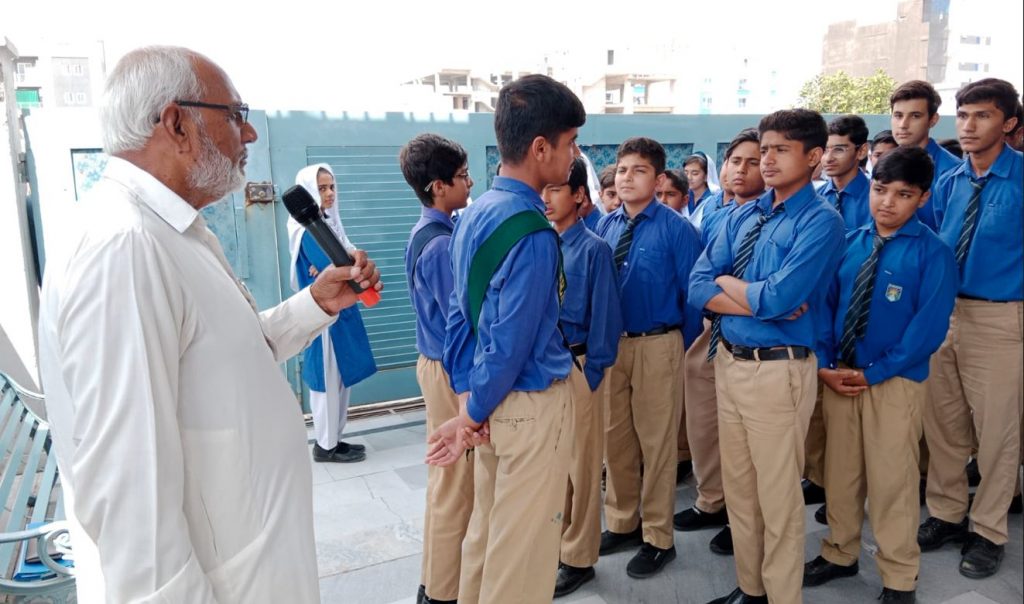
During visit of Sector F-17 in Islamabad, it was noticed that children visiting the local parks use to spread rappers and other garbage in the parks. A team of e-guard visited the area and motivated the children in T& T Colony School and Apple School in MPCHS, F-17 where children were apprised how they can take of not only their own waste but their home and community’s best to improve the ambience of their localities and create a sense of responsibility among them. AHKMT played its part and asked the school students to throw their garbage in dust bins and should not be littering around randomly.
Some of the students even asked that in case they don’t have dust bins then what should they do. They were asked to collect all of their waste is a polythene bag and dispose it in a safe manner. They were also asked to raise their voices before the local management for putting up dustbins where necessary so that garbage is not littered around.
Children are naturally curious and creative so we must engage our imagination and start looking at waste and recyclables as useful materials and give them a new life. Turning plastic bottles into planters and starting an herb garden, creating mosaic art from bottle caps and turning cereal boxes into a periscope or a kaleidoscope help kids think creatively. Activities like these are fun and engaging. They also aid in the learning process of the children and make them more conscious from a very young age.